
Many users assume a privacy-focused wallet is just “private by default” and that installing one solves all risks. That shorthand is convenient but misleading. In practice, meaningful privacy requires choices at the network, key-management, protocol, and UX levels — and each choice forces trade-offs between convenience, interoperability, and attack surface. In this piece I compare approaches and show how a well-engineered multi-currency wallet balances those trade-offs for Monero, Bitcoin, Litecoin and others while flagging the limits you must accept or mitigate yourself.
The goal here is practical: explain how network anonymity, local key security, on-device privacy for Monero, optional privacy tools for Bitcoin and Litecoin, and built-in exchange routing fit together — and where they break. If you use or are evaluating wallets in the US market, you’ll leave with a clearer mental model for when a wallet improves privacy and when it merely offers the appearance of it.
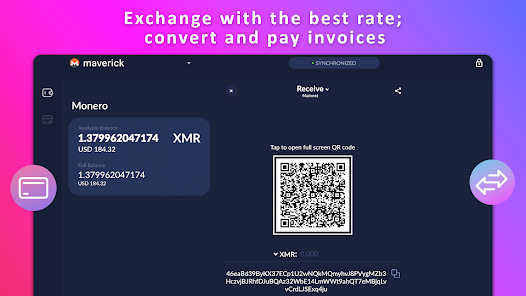
Mechanics: the privacy stack and why each layer matters
Privacy is not binary. Think of it as a stack where each layer provides defenses against different threats. The network layer hides where you connect from (IP address and timing cues). The wallet software layer keeps private keys and view keys on-device and limits telemetry. The protocol layer — different across Monero, Bitcoin, Litecoin, Zcash — dictates what metadata a blockchain reveals. Finally, the exchange or swap layer can reintroduce central points of observation unless done without intermediaries.
A practical wallet intended for privacy-aware users should therefore offer: Tor and I2P support for network anonymity; device-level encryption and biometric or PIN authentication; open-source, non-custodial key management so keys never leave the device; and privacy-respecting swap routing that avoids single centralized brokers. The integration of these features matters more than any one item on its own.
How Cake Wallet assembles the stack — strengths and limits
The wallet under discussion stitches together the layers above in a way that focuses on operational privacy and multi-currency use. Notable architectural choices: open-source, non-custodial design; device-level encryption (Secure Enclave on iOS, TPM on Android); Tor-only mode and I2P proxy support; and the option to connect to custom nodes. Those elements are the core privacy hygiene rules: they reduce third-party surveillance, confine secrets to hardware-protected enclaves, and anonymize network traffic where possible.
On the protocol side the wallet supports Monero’s privacy primitives natively: background synchronization, subaddresses, and a design where the private view key never leaves your device. For Litecoin it supports the MWEB (MimbleWimble Extension Blocks) privacy extension — an optional layer that can obscure amounts and outputs when activated. Bitcoin receives a suite of privacy tools (Silent Payments, PayJoin v2, UTXO coin control, and batching) that let users actively improve privacy at the transaction construction stage.
Cake Wallet also integrates decentralized cross-chain routing via NEAR Intents for in-wallet swaps, which finds competitive on-chain paths across multiple market makers without relying on a single centralized intermediary. That reduces counterparty observation risk compared with routing swaps through a custodial exchange. Hardware wallet support (Ledger, and an air-gapped Cupcake device) raises the bar for theft and malware attacks by moving signing offline.
Common myths vs reality — concrete corrections
Myth: “If my wallet uses Tor, transactions are anonymous.” Reality: Tor hides your IP to the node you connect to, but metadata can leak at other points — for example, on-chain linkage in Bitcoin or when using transparent Zcash unless shielding is enforced. The wallet mitigates this by offering Tor and I2P, plus the ability to use custom nodes, but the protocol-level metadata still exists and must be addressed through transaction construction (e.g., PayJoin) or protocol features (MWEB for LTC, Monero’s ring signatures).
Myth: “Open-source means perfect privacy.” Reality: Open source reduces the chance of hidden telemetry and allows audits, but privacy depends on correct configuration and user behavior. Cake Wallet’s zero-data-collection policy and visible code are strong signals, yet users must still protect backups, avoid address reuse when relevant, and understand which features (like MWEB or shielding) they enable.
Where the system breaks or constrains users
No wallet eliminates all risk. There are specific, practical limits you must accept or handle: first, the Zcash migration limitation — seed incompatibilities with Zashi wallets mean users must manually transfer ZEC into a newly created Cake ZEC wallet. That’s a friction point and a potential opportunity for mistakes during migration.
Second, optional privacy layers are just that: optional. MWEB for Litecoin must be activated to hide amounts and outputs. If you transact with counterparties who do not support MWEB, you can leak links. Third, on-device protections depend on your device security: hardware-backed encryption helps, but rooted or compromised devices can leak secrets. Finally, decentralized swap routing reduces central observation but still depends on market makers and liquidity; in low-liquidity scenarios there may be fewer private routes and higher slippage.
Decision framework: which wallet features to prioritize for different users
To choose what matters most, match threat model to feature set.
– Threat: casual on-chain linkability (everyday privacy). Prioritize: PayJoin v2, UTXO coin control, subaddresses (Monero), avoid address reuse, and use Tor for node connections.
– Threat: network-level surveillance (ISP or location fingerprinting). Prioritize: Tor-only mode, I2P support, and custom node connections so you can avoid exposing your IP to public nodes.
– Threat: device theft or malware. Prioritize: hardware wallet integration (Ledger/Cupcake), device-level encryption, and strong local authentication. Keep seed phrases offline and use air-gapped signing where practical.
– Threat: mixing funds across chains or swapping privately. Prioritize: decentralized routing (NEAR Intents), in-wallet swaps to avoid withdrawals to exchanges, and pick liquidity windows to reduce on-chain traceability.
Practical heuristics and a short checklist
One reusable mental model: protect “secrets at rest” (keys, view keys) and “secrets in motion” (IP, timing, swap counterparty). For “at rest,” insist on non-custodial, hardware-backed keys and offline backups. For “in motion,” use Tor/I2P, custom nodes, and in-wallet decentralized swapping where available.
Checklist you can run through in five minutes: enable Tor, confirm hardware encryption active, create subaddresses for recurring receipts (Monero), enable MWEB for LTC if you need amount privacy, and test a small swap via NEAR Intents to confirm routing behavior. Keep your ZEC migration plan in mind if moving from other wallets — it may require manual transfers.
What to watch next
Privacy tech evolves through protocol upgrades and changes in liquidity and node ecosystems. Watch for broader adoption of MWEB-style privacy extensions and for PayJoin/PSBT improvements in Bitcoin wallets. Also monitor liquidity provider diversity for NEAR Intents-style routing: more market makers means better on-chain privacy through better routing options; concentrated liquidity can reintroduce observation risk. Finally, regulatory attention in the US and elsewhere may affect how exchanges and market makers participate in private routing — if regulatory constraints increase, expect changes in available swap paths or KYC requirements for certain counterparts.
If you want a single place to explore these features and configure them on multiple platforms, consider exploring cake wallet for a hands-on look at the privacy stack described above.
FAQ
Q: Does using Tor mean my on-chain transactions are anonymous?
A: No — Tor hides the network origin of your node requests, which protects your IP from the node, but it does not alter blockchain metadata. For Bitcoin and Litecoin you still need privacy-preserving transaction construction (PayJoin, coin control, MWEB when available) to reduce on-chain linkability. Monero’s protocol provides stronger default anonymity, but network-level anonymity still matters.
Q: How secure are in-wallet swaps compared with centralized exchanges?
A: In-wallet swaps using decentralized routing (like NEAR Intents) reduce custody and central observation risks, because you avoid sending funds to a centralized intermediary. However, swaps still depend on liquidity providers and on-chain settlement — in low-liquidity markets you may see worse rates or fewer private routes. They’re safer from custody loss but not magically immune to all metadata leakage.
Q: I use Zcash — what is the migration problem mentioned?
A: There’s a specific compatibility issue: seed phrases from Zashi wallets are incompatible because of differences in how change addresses are handled. The practical implication is that users must create a Cake ZEC wallet and manually transfer funds rather than restoring from a seed. Treat this as operational friction and plan the transfer carefully to avoid mistakes.
Q: Should I always enable MWEB for Litecoin?
A: If your goal is to obscure amounts and outputs, MWEB helps, but enabling it is a trade-off: transactions that interact with parties not supporting MWEB may reveal links or require special handling. Use it when both sides support MWEB or when you want the additional layer of privacy for your LTC holdings.